

Update – Serviio version 2.0 is a new major version, so existing Serviio 1.x licences will not unlock the Pro features without a fresh licence purchase. If you wish to downgrade back to version 1.10.1 you may manually install the older package (merged architectures, or evansport) but your media library will need to be rebuilt.
Running the Serviio DLNA server on a NAS is a very efficient solution. It allows all your media to be constantly available to all your devices, all without the need for a dedicated media PC. Most TV and Bluray players are already capable media renderers – so indexing the library, retrieving metadata, and streaming the content are where Serviio fits in. Device support is continually improved by a community of contributors, and this crowd-sourced aspect was what initially drew me to the project, leading me to create the Sony Bluray device profile back in 2010. Serviio can also connect to online sources of content such as catch-up TV portals and allow fuss free content playback without advertising, even on devices which lack native support. These online plugins are also community maintained.
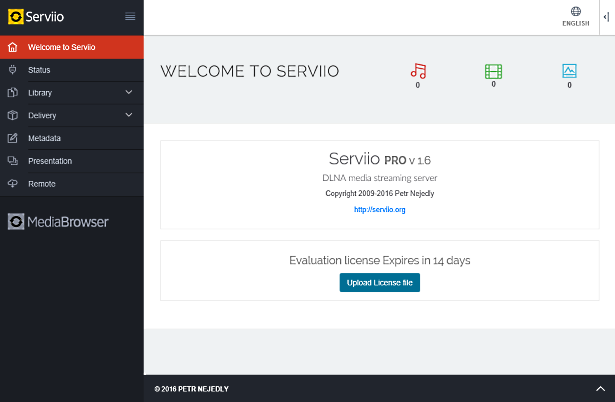
This new version of the Synology package updates Serviio to version 2.0 which fixes some issues and introduces multiple user support (release notes). Version 1.10 improved MediaBrowser, and also 4K media support. Version 1.9 replaced the Flash Player dependency in MediaBrowser with an HTML5 player. Serviio 1.7 brought audio track selection preferences, and automatic subtitle downloading. The most significant enhancement from version 1.6 onwards is the new web management console which removes the need to install the separate Serviio Console application on a computer. The web console uses a modern adaptive design which works well on mobile devices, and it is now integrated with DSM so you will see its icon in the application menu when the package is running:

The package supports hardware transcoding on the DS214play and DS415play with Intel Evansport media processor. This support required substantial personal effort and was made possible by the very kind donation of a new DS214play unit from MrK/Boretom a fellow package maintainer for ASUStor devices.
Limitations
If you use a TV, Bluray or media player bought in the last few years it is likely to have very good format support. In this case even a low specification NAS will be adequate for streaming most video content. There are some limitations however, in particular with video transcoding.
Serviio’s MediaBrowser is a Pro version only feature, and is designed to allow direct playback of media on tablet devices without the need for dedicated apps. Please note that Apple iOS devices require video in H.264 and audio in stereo AAC format when streaming. With the exception of the “play” models already mentioned, most Synology NAS models lack the CPU power to transcode video into H.264 in realtime. Even if the source video is already H.264, ARMv5 family CPUs (which lack an FPU) in the older models lack the power even to transcode AAC audio in realtime without libfdk_aac. Unfortunately I am unable to distribute an FFmpeg binary compiled against this library under the terms of its software license.
Ever since Serviio version 1.2 renderers that do not natively support subtitles via DLNA can have them burned into the video during transcoding, but as already explained a NAS usually lacks the CPU power to do this (more info on subs here). If you absolutely need hard subs for a particular film, you could start playback on your device then stop it and Serviio will continue transcoding. Then you will be able to try again in a few hours since it will play from the transcode cache folder. Newer TVs tend to support inline SRT subs, but for those with older models I can recommend the PlayStation 4 Media Player as a competent DLNA renderer with inline subs support.
I was able to compile FFmpeg for all eight supported architectures (ARMv5, ARMv7, ARMv7 with NEON, ARMv8, Intel i686, Intel x64, Intel Evansport media processor, and PowerPC e500v2) with the additional libraries Serviio requires while using the libs included within DSM as far as possible. I have published my compilation methods to make the process easier for others in future since parts of it were difficult to figure out. Only the Intel CPU or higher end ARM CPUs are likely to be of any practical use transcoding to H.264, since the other CPU types lack vector units (no AltiVec in QorIQ/PowerQUICC, and no NEON in Armada 370/XP).
Synology Package Installation
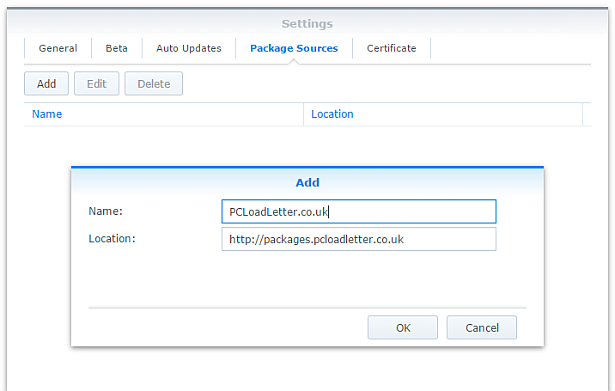
- In Synology DSM’s Package Center, click Settings and add my package repository:
- The repository will push its certificate automatically to the NAS, which is used to validate package integrity. Set the Trust Level to Synology Inc. and trusted publishers:

- Serviio now requires Java 8 for OS-native filesystem watching, so you will need to install my Java SE Embedded package first if you have not already done so. Read the instructions on that page carefully too.
- Now browse the Community section in Package Center to install Serviio:

Community packages are not listed in the All category for some reason. The repository only displays packages which are compatible with your specific model of NAS. If you don’t see Serviio in the list, then either your NAS model or your DSM version are not supported at this time. DSM 6.0 is the minimum supported version for this package. - When Serviio is started for the first time, a plugins folder will be created in the public shared folder (usually /volume1/public/serviio/plugins/). Download any Serviio online content plugins that you require and place the .groovy files in that location.
- If you need subtitle support for glyphs not present in the default DejaVu fonts, add additional fonts to the following folder inside your NAS’s public shared folder (usually /volume1/public/serviio/fonts/).
Notes
- You should reserve an IP address for your NAS (most home broadband routers will let you do this in the DHCP options), or use a static IP address. This will prevent Serviio from appearing multiple times in the menus of your renderer devices as its IP changes.
- In the console disable ‘Generate thumbnails for local videos’ in the Metadata tab. Failure to do this can make adding videos to your library very slow on older NAS systems. With this disabled Serviio will still fetch thumbnail images automatically from the online databases.
- Don’t alter the transcoded files location on the Transcoding tab, it’s already set to a sensible location for Synology systems. This particular folder is deleted each time your NAS restarts, and Serviio cleans up its temp files automatically in any case.
- When adding folders to the media library use the Browse button. This will show the root of the entire NAS Linux filesystem, so you will find your DSM shared folders inside /volume1.
- If you’re upgrading from a previous Serviio version you should check for updates of your online content plugins.
- MediaBrowser (Pro only feature) can be opened using the link in the side bar of the web console (http://IPofYourNAS:23424/mediabrowser). If you want to use the MediaBrowser from a remote location you would need to either port forward 23424 on your router, or use SSH tunnelling. You can also manage Serviio remotely by SSH tunnelling port 23423 which the console uses. Both of these service definitions are added to the DSM Firewall.
- Advanced users who wish to edit device profiles or enable debug logging can find the Serviio files in /var/packages/Serviio/target. You will need to use an SSH session to access this folder – it cannot be navigated to using DSM’s File Station. You will need to restart the Serviio package for profile changes to take effect.
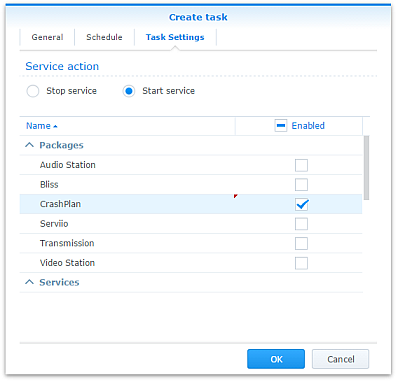
- Some users may wish to restrict running Serviio to specific times of day in order to free up RAM for a scheduled backup window for instance. This can be achieved by creating tasks to start and stop Serviio using the Task Scheduler in DSM Control Panel:
- The package uses an FFmpeg wrapper script to modify the usual transcoding behaviour of Serviio to use the Intel Evansport hardware decoding and encoding available in the DS214play and DS415play models. I have left the FFmpeg wrapper scripts in the package even when not in use (in the Serviio/bin folder), because they are still useful for people trying to test a particular workaround or encoder setting. The wrapper was a tricky script to get working due to variable expansion precedence issues and quote handling. If you need it, just change the ffmpeg.location system property in /var/packages/Serviio/target/bin/serviio.sh to point to your modified wrapper script.
- If additional fonts are not working as expected, some troubleshooting is available. You can re-create the fontconfig cache by connecting to the NAS via an SSH session as admin, and then running:
sudo -i

(enter admin password to become root)

rm -rf ~/.fontconfig.cache

FC_DEBUG=128 /var/packages/Serviio/target/bin/fc-cache --verbose
Hardware transcoding support
- DS214play and DS415play with Intel Evansport SoC are the only models supported for hardware transcoding. Serviio uses the multimedia tool FFmpeg for manipulating media files, and I am only able to build a hardware-assisted FFmpeg for DS214play and DS215play. Subsequent to those products, Synology has marketed a number of other systems with hardware transcoding features but these are not supported by Serviio.
The DS216play with STiH412 Monaco SoC uses a specialised build of Gstreamer for the Synology transcoding solution rather than FFmpeg, so its hardware features cannot be used by Serviio.
It seems likely that Synology is also using Gstreamer for the Intel Braswell or newer generation CPUs with QuikSync, since DSM ships with an older FFmpeg (2.7.1) than the version which introduced QuikSync support (2.8.0). To implement FFmpeg QuikSync hardware transcoding support requires Linux kernel patches for libmfx support which is not currently included in DSM 6.x, so Serviio support for Intel QuikSync on Synology is unlikely unless Synology in future switches to using FFmpeg for its own hardware transcoding solution.
The DS218play with Realtek RTD1296 SoC uses Gstreamer with OpenMAX drivers for the Synology transcoding solution. Although I was able to compile the ARMv8 build of FFmpeg with libomx support, unfortunately the Belaggio OpenMAX IL will not register these Realtek drivers which are distributed in the VideoStation package, therefore the hardware transcoding features of this model cannot be used by Serviio. - For the supported systems FFmpeg will use hardware decoding wherever possible.
- Although multiple hardware assisted decodes can take place simultaneously, only a single hardware encode is available. The package intelligently avoids race conditions for this.
- Any FFmpeg commandline to encode using libx264 will automatically be sent to the hardware encoder when available.
- profiles.xml has been modified so that the preferred transcode format for most devices for non-natively supported videos is H.264.
- In order to add hardware H.264 encoding to a device profile, specify h264 as the desired codec and the FFmpeg wrapper script will make the necessary substitution automatically.
- When the hardware encoder is used, the low quality settings in Serviio’s default libx264 options to favour encoding speed are ignored. The hardware encoder performance is not altered by quality settings.
- If a media stream is being both hardware decoded and hardware encoded, it will use pipelined mode. Based on responses from Synology support during development this means that both jobs occur on the media processor without exposing the intermediate bitstream to FFmpeg. Consequently it is not possible to burn subtitles in pipelined mode. As a result my FFmpeg wrapper script will run the decode part of the job in software in order to do this. The unfortunate result is that the encoder cannot quite achieve real time transcoding during subtitle compositing. For full 1080p HD material it achieves around 20fps, whereas most movies are 24fps. This means that in order to watch a film with hard subs you would need to start it off, pause or stop the renderer and return a bit later to view. An alternative would be to mux the content into an MKV container with the desired subtitles before adding it to the Serviio library, assuming that your device supports SRTs in MKV.
- The hardware encoded H.264 streams are not 100% compliant with the specification and fail validation using the tool DGAVCDec. For most tested renderers this does not affect playback (Bravia, Sony Bluray, iOS). FlowPlayer which had been the embedded player in MediaBrowser did not play these files satisfactorily and dropped many frames resulting in jerky playback. However since Serviio version 1.9 MediaBrowser uses an HTML5 player which is not affected by this issue.
Package scripts
For information, here are the package scripts so you can see what it’s going to do. You can get more information about how packages work by reading the Synology 3rd Party Developer Guide.
installer.sh
#!/bin/sh

#--------SERVIIO installer script
#--------package maintained at pcloadletter.co.uk


DOWNLOAD_PATH="http://download.serviio.org/releases"
DOWNLOAD_FILE="serviio-2.0-linux.tar.gz"
EXTRACTED_FOLDER="serviio-2.0"
DOWNLOAD_URL="${DOWNLOAD_PATH}/${DOWNLOAD_FILE}"
SYNO_CPU_ARCH="`uname -m`"
[ "${SYNO_CPU_ARCH}" == "x86_64" ] && SYNO_CPU_ARCH="x64"
[ "${SYNOPKG_DSM_ARCH}" == "comcerto2k" ] && SYNO_CPU_ARCH="armneon"
[ "${SYNOPKG_DSM_ARCH}" == "armada375" ] && SYNO_CPU_ARCH="armneon"
[ "${SYNOPKG_DSM_ARCH}" == "armada38x" ] && SYNO_CPU_ARCH="armneon"
[ "${SYNOPKG_DSM_ARCH}" == "alpine" ] && SYNO_CPU_ARCH="armneon"
[ "${SYNOPKG_DSM_ARCH}" == "alpine4k" ] && SYNO_CPU_ARCH="armneon"
[ "${SYNOPKG_DSM_ARCH}" == "monaco" ] && SYNO_CPU_ARCH="armneon"
[ "${WIZARD_ENC_HW}" == "true" ] && SYNO_CPU_ARCH="i686evansport"
NATIVE_BINS_URL="http://packages.pcloadletter.co.uk/downloads/serviio-native-${SYNO_CPU_ARCH}.tar.xz"
NATIVE_BINS_FILE="`echo ${NATIVE_BINS_URL} | sed -r "s%^.*/(.*)%\1%"`"
FONTS_URL="http://sourceforge.net/projects/dejavu/files/dejavu/2.37/dejavu-fonts-ttf-2.37.tar.bz2"
FONTS_FILE="`echo ${FONTS_URL} | sed -r "s%^.*/(.*)%\1%"`"
#'ua' prefix means wget user-agent will be customized
INSTALL_FILES="ua${DOWNLOAD_URL} ${NATIVE_BINS_URL} ${FONTS_URL}"
PID_FILE="${SYNOPKG_PKGDEST}/serviio.pid"
COMMENT="# Synology Serviio Package"
TEMP_FOLDER="`find / -maxdepth 2 -path '/volume?/@tmp' | head -n 1`"
PUBLIC_FOLDER="`synoshare --get public | sed -r "/Path/!d;s/^.*\[(.*)\].*$/\1/"`"
PLUGINS_PATH="${PUBLIC_FOLDER}/serviio"
source /etc/profile


pre_checks ()
{
  #These checks are called from preinst and from preupgrade functions to prevent failures resulting in a partially upgraded package
  if [ -z ${JAVA_HOME} ]; then
    echo "Java is not installed or not properly configured. JAVA_HOME is not defined. " >> $SYNOPKG_TEMP_LOGFILE
    echo "Download and install the Java Synology package from http://wp.me/pVshC-z5" >> $SYNOPKG_TEMP_LOGFILE
    exit 1
  fi

  if [ ! -f ${JAVA_HOME}/bin/java ]; then
    echo "Java is not installed or not properly configured. The Java binary could not be located. " >> $SYNOPKG_TEMP_LOGFILE
    echo "Download and install the Java Synology package from http://wp.me/pVshC-z5" >> $SYNOPKG_TEMP_LOGFILE
    exit 1
  fi

  JAVA_VER=`java -version 2>&1 | sed -r "/^.* version/!d;s/^.* version \"[0-9]\.([0-9]).*$/\1/"`
  if [ ${JAVA_VER} -lt 8 ]; then
    echo "This version of Serviio requires Java 8 or newer. Please update your Java package. " >> $SYNOPKG_TEMP_LOGFILE
    exit 1
  fi

  if [ -z ${PUBLIC_FOLDER} ]; then
    echo "A shared folder called 'public' could not be found - note this name is case-sensitive. " >> $SYNOPKG_TEMP_LOGFILE
    echo "Please create this using the Shared Folder DSM Control Panel and try again." >> $SYNOPKG_TEMP_LOGFILE
    exit 1
  fi
}


preinst ()
{
  pre_checks
  cd ${TEMP_FOLDER}
  for WGET_URL in ${INSTALL_FILES}
  do
    WGET_FILENAME="`echo ${WGET_URL} | sed -r "s%^.*/(.*)%\1%"`"
    [ -f ${TEMP_FOLDER}/${WGET_FILENAME} ] && rm ${TEMP_FOLDER}/${WGET_FILENAME}
    #this will allow serviio.org to track the number of downloads from Synology users
    WGET_URL=`echo ${WGET_URL} | sed -e "s/^ua/--user-agent=Synology --referer=http:\/\/pcloadletter.co.uk\/2012\/01\/25\/serviio-syno-package /"`
    wget ${WGET_URL}
    if [ $? != 0 ]; then
      if [ -d ${PUBLIC_FOLDER} ] && [ -f ${PUBLIC_FOLDER}/${WGET_FILENAME} ]; then
        cp ${PUBLIC_FOLDER}/${WGET_FILENAME} ${TEMP_FOLDER}
      else
        echo "There was a problem downloading ${WGET_FILENAME} from the official download link, " >> $SYNOPKG_TEMP_LOGFILE
        echo "which was \"${WGET_URL}\" " >> $SYNOPKG_TEMP_LOGFILE
        echo "Alternatively, you may download this file manually and place it in the 'public' shared folder. " >> $SYNOPKG_TEMP_LOGFILE
        exit 1
      fi
    fi
  done

  exit 0
}


postinst ()
{
  #extract the downloaded Serviio archive
  cd ${TEMP_FOLDER}
  tar xzf ${TEMP_FOLDER}/${DOWNLOAD_FILE}
  rm ${TEMP_FOLDER}/${DOWNLOAD_FILE}
  cp -R ${TEMP_FOLDER}/${EXTRACTED_FOLDER}/* ${SYNOPKG_PKGDEST}
  if [ ! -z "${EXTRACTED_FOLDER}" ]; then
    rm -r ${TEMP_FOLDER}/${EXTRACTED_FOLDER}
  fi
  if [ ! -d "${PLUGINS_PATH}/plugins" ]; then
    mkdir -p ${PLUGINS_PATH}/plugins
  fi
  if [ ! -d "${PLUGINS_PATH}/fonts" ]; then
    mkdir -p ${PLUGINS_PATH}/fonts
  fi

  #extract CPU-specific additional binaries
  cd ${SYNOPKG_PKGDEST}/lib
  tar xJf ${TEMP_FOLDER}/${NATIVE_BINS_FILE} && rm ${TEMP_FOLDER}/${NATIVE_BINS_FILE}
  mv ${SYNOPKG_PKGDEST}/lib/ffmpeg ${SYNOPKG_PKGDEST}/bin
  mv ${SYNOPKG_PKGDEST}/lib/fc-cache ${SYNOPKG_PKGDEST}/bin
  [ -e ${SYNOPKG_PKGDEST}/lib/omxregister-bellagio ] mv ${SYNOPKG_PKGDEST}/lib/omxregister-bellagio ${SYNOPKG_PKGDEST}/bin

  #remove legacy package font versions
  [ -d ${PLUGINS_PATH}/fonts/dejavu-fonts-ttf-2.33/ ] && rm -rf ${PLUGINS_PATH}/fonts/dejavu-fonts-ttf-2.33/
  [ -d ${PLUGINS_PATH}/fonts/dejavu-fonts-ttf-2.34/ ] && rm -rf ${PLUGINS_PATH}/fonts/dejavu-fonts-ttf-2.34/
  [ -d ${PLUGINS_PATH}/fonts/dejavu-fonts-ttf-2.35/ ] && rm -rf ${PLUGINS_PATH}/fonts/dejavu-fonts-ttf-2.35/

  #extract open source font package for subtitle support during transcoding
  cd ${PLUGINS_PATH}/fonts
  tar xvjf ${TEMP_FOLDER}/${FONTS_FILE} && rm ${TEMP_FOLDER}/${FONTS_FILE}
  sed -i "s|WINDOWSFONTDIR|${PLUGINS_PATH}/fonts|" ${SYNOPKG_PKGDEST}/config/fonts/fonts.conf
  sed -i "s|WINDOWSTEMPDIR_FONTCONFIG_CACHE|~/.fontconfig.cache|" ${SYNOPKG_PKGDEST}/config/fonts/fonts.conf

  #wrapper script can be useful for testing different encoder options
  if [ -e "${SYNOPKG_PKGDEST}/bin/ffmpeg-wrapper-${SYNO_CPU_ARCH}.sh" ]; then
    #we need to use the wrapper to make FFmpeg use libshine on ARM systems and to use hardware decode/encode on Intel Evansport systems
    FFMPEG_PATH="\$SERVIIO_HOME/bin/ffmpeg-wrapper-${SYNO_CPU_ARCH}.sh"
  else
    FFMPEG_PATH="\$SERVIIO_HOME/bin/ffmpeg"
  fi

  #modifications to device profiles (evansport hardware transcoding)
  if [ -e "${SYNOPKG_PKGDEST}/config/profiles-${SYNO_CPU_ARCH}.xml" ]; then
    mv "${SYNOPKG_PKGDEST}/config/profiles.xml" "${SYNOPKG_PKGDEST}/config/profiles-orig.xml"
    mv "${SYNOPKG_PKGDEST}/config/profiles-${SYNO_CPU_ARCH}.xml" "${SYNOPKG_PKGDEST}/config/profiles.xml"
  fi

  #modifications to application profiles (evansport hardware transcoding)
  #removed owing to frame drops in FlowPlayer because encoder does not produce 100% valid streams, evansport has sufficient power for flv encoding
  #if [ -e "${SYNOPKG_PKGDEST}/config/application-profiles-${SYNO_CPU_ARCH}.xml" ]; then
  #  mv "${SYNOPKG_PKGDEST}/config/application-profiles-${SYNO_CPU_ARCH}.xml" "${SYNOPKG_PKGDEST}/config/application-profiles.xml"
  #fi

  #make changes to Serviio launcher script so that pid file is created for Java process
  sed -r -i "s%Execute the JVM in the foreground%Execute the JVM in the background%" ${SYNOPKG_PKGDEST}/bin/serviio.sh
  sed -r -i "s%^(exec \"$JAVA.*)$%\1 \&%" ${SYNOPKG_PKGDEST}/bin/serviio.sh
  echo "echo \$! > ${PID_FILE}" >> ${SYNOPKG_PKGDEST}/bin/serviio.sh

  #set some additional Serviio system properties (temp folder, FFmpeg path, plugins folder)
  #http://www.serviio.org/index.php?option=com_content&view=article&id=43
  EXTRA_OPTS="-Dserviio\.defaultTranscodeFolder=${TEMP_FOLDER} -Dffmpeg\.location=${FFMPEG_PATH} -Dplugins\.location=${PLUGINS_PATH}"
  #fix Java prefs checking which was preventing NAS hibernation http://forum.serviio.org/viewtopic.php?f=5&t=6878
  EXTRA_OPTS="${EXTRA_OPTS} -Djava.util.prefs.syncInterval=86400"
  if [ "${SYNO_CPU_ARCH}" == "armv5tel" ]; then
    #use integer math (not floating point) Dolby AC-3 encoder for better performance on ARM CPUs
    #http://ffmpeg.org/ffmpeg.html#ac3-and-ac3_005ffixed
    EXTRA_OPTS="${EXTRA_OPTS} -Dserviio\.fixedPointEncoders"
  fi
  sed -r -i "s% -Dffmpeg\.location=ffmpeg%%; s%^(JAVA_OPTS=.*)\"$%\1 ${EXTRA_OPTS}\"%" ${SYNOPKG_PKGDEST}/bin/serviio.sh

  #create log file to allow package start errors to be captured
  [ -e ${SYNOPKG_PKGDEST}/log ] || mkdir ${SYNOPKG_PKGDEST}/log
  [ -e ${SYNOPKG_PKGDEST}/log/serviio.log ] || touch ${SYNOPKG_PKGDEST}/log/serviio.log

  #add firewall config
  /usr/syno/bin/servicetool --install-configure-file --package /var/packages/${SYNOPKG_PKGNAME}/conf/${SYNOPKG_PKGNAME}.sc > /dev/null

  exit 0
}


preuninst ()
{
  `dirname $0`/stop-start-status stop

  exit 0
}


postuninst ()
{
  #remove fontconfig configuration
  sed -i "/${COMMENT}/d" /root/.profile

  #remove firewall config
  if [ "${SYNOPKG_PKG_STATUS}" == "UNINSTALL" ]; then
    /usr/syno/bin/servicetool --remove-configure-file --package ${SYNOPKG_PKGNAME}.sc > /dev/null
  fi

  #remove legacy daemon user and homedir
  [ -e /var/services/homes/serviio ] && synouser --del serviio
  [ -e /var/services/homes/serviio ] && rm -r /var/services/homes/serviio

  exit 0
}


preupgrade ()
{
  `dirname $0`/stop-start-status stop
  pre_checks
  #if a media database exists we need to preserve it
  if [ -d ${SYNOPKG_PKGDEST}/library/db ]; then
    mkdir ${SYNOPKG_PKGDEST}/../${SYNOPKG_PKGNAME}_db_migration
    mv ${SYNOPKG_PKGDEST}/library/db ${SYNOPKG_PKGDEST}/../${SYNOPKG_PKGNAME}_db_migration
  fi

  exit 0
}


postupgrade ()
{
  #use the backed up media database from the previous version
  if [ -d ${SYNOPKG_PKGDEST}/../${SYNOPKG_PKGNAME}_db_migration/db ]; then
    mv ${SYNOPKG_PKGDEST}/../${SYNOPKG_PKGNAME}_db_migration/db ${SYNOPKG_PKGDEST}/library
    rmdir ${SYNOPKG_PKGDEST}/../${SYNOPKG_PKGNAME}_db_migration
  fi
  chown -R root:root ${SYNOPKG_PKGDEST}

  exit 0
}
start-stop-status.sh
#!/bin/sh

#--------SERVIIO start-stop-status script
#--------package maintained at pcloadletter.co.uk

PKG_FOLDER="/var/packages/Serviio"
ENGINE_CFG="${PKG_FOLDER}/target/bin/serviio.sh"
ENGINE_SCRIPT="${PKG_FOLDER}/target/bin/serviio.sh"
PID_FILE="${PKG_FOLDER}/target/serviio.pid"
DNAME="Serviio"
DLOG="${PKG_FOLDER}/target/log/serviio.log"
COMMENT="# Synology Serviio Package"
TIMESTAMP="`date "+%F %X,000"`"
source /etc/profile
source /root/.profile


EnvCheck ()
#updates to DSM will reset these changes so check them each startup
{
  #/root/.profile should contain 2 lines added by this package tagged with trailing comments
  COUNT=`grep -c "$COMMENT$" /root/.profile`
  if [ $COUNT != 2 ]; then

    #remove any existing mods
    sed -i "/${COMMENT}/d" /root/.profile

    #add required environment variables
    echo "export FONTCONFIG_FILE=fonts.conf ${COMMENT}" >> /root/.profile
    echo "export FONTCONFIG_PATH=${PKG_FOLDER}/target/config/fonts ${COMMENT}" >> /root/.profile
  fi
}

start_daemon ()
{
  EnvCheck
  source /root/.profile

  #create/refresh fontconfig cache - prevents delay the first time that FFmpeg renders hard subs
  #FC_DEBUG=128 fc-cache --verbose
  ${PKG_FOLDER}/target/bin/fc-cache

  #refresh hostname in Serviio instance name - recently DSM has modified the hosts file and broken localhost name resolution
  sed -i -r "s%<FriendlyName>Serviio \((\{computerName\})\)%<FriendlyName>Serviio \(`hostname`\)%" $PKG_FOLDER/target/config/profiles.xml

  #set appropriate Java max heap size
  RAM=$((`free | grep Mem: | sed -e "s/^ *Mem: *\([0-9]*\).*$/\1/"`/1024))
  if [ $RAM -le 128 ]; then
    JAVA_MAX_HEAP=80
  elif [ $RAM -le 256 ]; then
    JAVA_MAX_HEAP=192
  elif [ $RAM -le 512 ]; then
    JAVA_MAX_HEAP=384
  #Serviio's default max heap is 512MB
  elif [ $RAM -gt 512 ]; then
    JAVA_MAX_HEAP=512
  fi
  sed -i -r "s/(^..JAVA.) -Xmx[0-9]+[mM] (.*$)/\1 -Xmx${JAVA_MAX_HEAP}m \2/" "${ENGINE_CFG}"
  echo "${TIMESTAMP} Starting ${DNAME}" >> ${DLOG}
  ${ENGINE_SCRIPT} > /dev/null 2>> ${DLOG}
  if [ -z ${SYNOPKG_PKGDEST} ]; then
    #script was manually invoked, need this to show status change in Package Center
    [ -e ${PKG_FOLDER}/enabled ] || touch ${PKG_FOLDER}/enabled
  fi
}

stop_daemon ()
{
  echo "${TIMESTAMP} Stopping ${DNAME}" >> ${DLOG}
  kill `cat ${PID_FILE}`
  wait_for_status 1 20 || kill -9 `cat ${PID_FILE}`
  rm -f ${PID_FILE}
  if [ -z ${SYNOPKG_PKGDEST} ]; then
    #script was manually invoked, need this to show status change in Package Center
    [ -e ${PKG_FOLDER}/enabled ] && rm ${PKG_FOLDER}/enabled
  fi
}

daemon_status ()
{
  if [ -f ${PID_FILE} ] && kill -0 `cat ${PID_FILE}` > /dev/null 2>&1; then
    return
  fi
  rm -f ${PID_FILE}
  return 1
}

wait_for_status ()
{
  counter=$2
  while [ ${counter} -gt 0 ]; do
    daemon_status
    [ $? -eq $1 ] && return
    let counter=counter-1
    sleep 1
  done
  return 1
}

case $1 in
  start)
    if daemon_status; then
      echo ${DNAME} is already running with PID `cat ${PID_FILE}`
      exit 0
    else
      echo Starting ${DNAME} ...
      start_daemon
      exit $?
    fi
  ;;

  stop)
    if daemon_status; then
      echo Stopping ${DNAME} ...
      stop_daemon
      exit $?
    else
      echo ${DNAME} is not running
      exit 0
    fi
  ;;

  restart)
    stop_daemon
    start_daemon
    exit $?
  ;;

  status)
    if daemon_status; then
      echo ${DNAME} is running with PID `cat ${PID_FILE}`
      exit 0
    else
      echo ${DNAME} is not running
      exit 1
    fi
  ;;

  log)
    echo "${DLOG}"
    exit 0
  ;;

  *)
    echo "Usage: $0 {start|stop|status|restart}" >&2
    exit 1
  ;;

esac
ffmpeg-wrapper-i686evansport.sh
#!/bin/sh

#FFmpeg wrapper script to enable hardware decoding and encoding on Intel Evansport CPUs
#wrapper originally posted here: http://forum.serviio.org/viewtopic.php?f=7&t=6458

FOLDER="`dirname $0`"
PARAMS=""
COMMANDLINE=$@
FFMPEG_BIN="ffmpeg"
INPUT=0
for PARAM in "$@"; do
  if [ ${INPUT} = 1 ]; then
    #the FFmpeg input filename/URL needs quotes adding back on
    #because it may contain spaces, and the shell has removed them
    PARAMS="${PARAMS} \"${PARAM}\""
    INPUT=0
  elif [ ${INPUT} = 2 ]; then
    #the FFmpeg subtitles filename needs quotes adding back on
    #because it may contain spaces, and the shell has removed them
    PARAM=${PARAM/\[*.*\]subtitles=filename=/subtitles=filename=\"}
    PARAM=${PARAM/:original_size/\":original_size}
    PARAMS="${PARAMS} ${PARAM}"
    INPUT=0
  elif [ "${PARAM}" == "-filter_complex" ]; then
    #next parameter will be subtitles filtergraph including subtitle filename
    #which needs special treatment, so set a flag
    INPUT=2
    PARAMS="${PARAMS} ${PARAM}"
  elif [ "${PARAM}" == "-i" ]; then
    #next parameter will be input filename which needs special treatment, so set a flag
    INPUT=1
    #enable hardware decoding by default, but not when Serviio is either:
    # gathering media metadata,
    # remuxing video,
    # generating thumbnails,
    # or rendering subtitles into the video stream (pipeline mode not supported for subs),
    if [ $# -lt 3 ] || \
       [ "${COMMANDLINE}" != "${COMMANDLINE/ -c:v copy /}" ] || \
       [ "${COMMANDLINE}" != "${COMMANDLINE/ pipe:/}" ] || \
       [ "${COMMANDLINE}" != "${COMMANDLINE/ -filter_complex \[*:*\]subtitles=/}" ]; then
      PARAMS="${PARAMS} -i"
    # or gathering online stream metadata
    elif [ $# -eq 4 ] && [ "${COMMANDLINE}" != "${COMMANDLINE/-analyzeduration /}" ]; then
      PARAMS="${PARAMS} -i"
    else
      PARAMS="${PARAMS} -prefer_smd -i"
    fi
  else
    PARAMS="${PARAMS} ${PARAM}"
  fi
done

#older Evansport FFmpeg version 2.7.1 needs "-strict -2" to use experimental aac encoder
if [ "${PARAMS}" != "${PARAMS/ -c:a:* aac /}" ]; then
  PARAMS="${PARAMS/ aac / aac -strict -2 }"
fi

#Is this FFmpeg commandline a candidate for the hardware encoder?
HWENC=0
if [ "${PARAMS}" != "${PARAMS/ -c:v libx264 /}" ]; then
  #check whether H.264 encoder is already busy with another Serviio/VideoStation session
  PID_HWENC=`cat /tmp/VideoStation/enabled 2> /dev/null | sed -r "s/.*\"PID\":([0-9]+),\"hardware_transcode.*$/\1/;s/\[//;s/\]//"`
  #is there an indicated PID?
  if [ -n "${PID_HWENC}" ]; then
    #there is an indicated PID - is it running?
    if ! kill -0 ${PID_HWENC}; then
      #the indicated PID is not in fact running, HW encoder is therefore available
      rm /tmp/VideoStation/enabled
      #make hardware H.264 encoder substitution to replace libx264
      HWENC=1
    fi
  else
    #there is no indicated PID, HW encoder is therefore available
    HWENC=1
  fi
fi

if [ ${HWENC} = 1 ]; then
  #make hardware H.264 encoder substitution to replace libx264
  PARAMS=${PARAMS/ libx264 / h264_smd }

  #by default Serviio's libx264 transcoding is intended for speed over quality, with SMD we can opt for better quality
  PARAMS="`echo ${PARAMS} | sed -r "s/ -crf [0-9]+ / /; s/ -g [0-9]+ / /"`"
  PARAMS=${PARAMS/ -preset:v veryfast / }
  PARAMS=${PARAMS/ -profile:v baseline / -profile:v high }
  PARAMS=${PARAMS/ -level 3 / -level 4.1 }
fi

#invoke FFmpeg
#log commandline, except media probes
#[ $# -gt 2 ] && echo "${FOLDER}/${FFMPEG_BIN} ${PARAMS}" >> ${FOLDER}/../log/ffmpeg-wrapper.log

#need to use eval here otherwise the quotes aren't handled properly
#http://fvue.nl/wiki/Bash:_Why_use_eval_with_variable_expansion%3F
eval ${FOLDER}/${FFMPEG_BIN} ${PARAMS}

#return FFmpeg status
exit $?
Changelog:
- 0037 05/Jun/19 – Updated to Serviio 2.0, clear your web browser cache to fix Serviio Console issues
- 0036 17/Apr/19 – Updated to Serviio 1.10.1, fixed missing Serviio console icon in DSM 6.2 main menu, added support for DS119j
- 0035 14/May/18 – Updated to Serviio 1.9.2
- 0034 01/Mar/18 – Updated to Serviio 1.9.1, added ARMv8 support
- 0033 02/Aug/17 – Updated to Serviio 1.9
- 0032 21/Jan/17 – Fixed Evansport FFmpeg wrapper script to allow transcoding to aac since it’s an older FFmpeg version with slightly different command syntax
- 0031 07/Jan/17 – Updated to Serviio 1.8
Updated FFmpeg to 3.2.2
Updated Intel Evansport hardware transcoding build of FFmpeg from 2.0.2 to 2.7.1 – now detects H.265 codec correctly
Fixed Intel Evansport FFmpeg support for transcoding DTS audio
FFmpeg now uses hard float ABI on systems with Armada 370/XP SoC (DSM 6.0 change)
FFmpeg now uses NEON on systems with Armada 375 SoC (DSM 6.0 change)
Disabled FFmpeg wrapper script to enable libshine for ARMv5 systems now that Serviio handles this automatically
Added Ogg Vorbis audio support to FFmpeg
Updated Deja-Vu fonts to 2.37
DSM 6.0 is now required due to greatly simplify FFmpeg compilation - 0030 21/May/16 – Updated to Serviio 1.6.1
- 0029 28/Jan/16 – Updated to Serviio 1.6, integrated the new built-in web console into DSM, fixed stupid wrapper bug which had broken evansport hardware transcoding on DS214play and DS415play, fixed online content when using evansport build. You must have already upgraded to version 1.5.2-0028 or else Package Center will report a TCP port conflict and will fail to upgrade the package. If you missed the 0028 update, install it manually in Package Center using the .spk file: (DS214play/DS415play), (all other models).
- 0028 08/Jan/16 – Serviio instance uses hostname rather than localhost, more accurate detection of DSM 6.0 on Intel CPUs which need x64 FFmpeg build, added DS216play support, fixed missing libgmp on DS3612xs running DSM 5.0, change to allow easy package upgrade to forthcoming Serviio 1.6
- 0027 12/Nov/15 – Substantial package re-write hence the long delay since the last release
Completely refreshed documentation, please re-read
Updated to Serviio version 1.5.2
Java 8 is now required – this is a Serviio imposed requirement
DSM 5.0 or newer is now required
Updated to FFmpeg 2.7.1 and many libs e.g. x264 at latest versions from late July 2015
Added optional hardware transcoding support for Intel Evansport systems (DS214play, DS415play) built using Synology-modified sources for FFmpeg 2.0.2
FFmpeg is now compiled with https support via GNUTLS library (useful for online streams via plugins)
Switched to using root account which was necessary for Evansport hardware encoding – no more adding account permissions, package upgrades will no longer break this
Added support for Mindspeed Comcerto 2000 CPU (comcerto2k – ARM Cortex-A9 with NEON) in DS414j
Added support for Intel Atom C2538 (avoton) CPU in DS415+
Fontconfig fc-cache utility now included to allow troubleshooting issues with adding new fonts for additional subtitle language support
Fontconfig variables checked on each package startup so DSM upgrades no longer break hard subs support
Updated DejaVu subtitle font to version 2.35
DSM Firewall application definitions added
Tested with DSM Task Scheduler to allow package to start/stop at certain times of day, saving RAM when not needed
Daemon init script now uses a proper PID file instead of the unreliable method of using grep on the output of ps
Daemon init script can be run from the command line
Improved accuracy of temp folder and plugins folder detection
Switched to .tar.xz compression for native binaries to reduce web hosting storage footprint
Package is now signed with repository private key
User Agent customization while downloading Serviio binaries from serviio.org to allow download stats gathering - 0026 25/Mar/14 – Updated to Serviio 1.4.1.2
- 0025 18/Mar/14 – Updated to Serviio 1.4.1.1
- 0024 30/Jan/14 – Updated to Serviio 1.4
- 0023 07/Nov/13 – Updated to FFmpeg 2.1 stable release
- 0022 30/Oct/13 – Added support for Intel Atom Evansport and Armada XP CPUs in new DSx14 products
- 0021 18/Oct/13 – Fixed zlib linking issue in QorIQ and Intel builds of FFmpeg
- 0020 05/Sep/13 – Updated to Serviio 1.3.1
- 0019 25/May/13 – Added support for Armada370 SoC used in DS213j (ARMv7 CPU with FPU)
- 0018 29/Mar/13 – Updated to Serviio 1.2.1, recompiled FFmpeg to use the libRTMP source code from serviio.org for consistency
- 0017 01/Mar/13 – Updated to Serviio 1.2
- 0016 23/Jan/13 – Fixes for DSM 4.2
- 015 30/Dec/13 – Updated to Serviio 1.1, fixed garbled ac3 encoding issue on ARM CPUs by compiling FFmpeg natively, rather than cross compiling. Remember to update your computer’s Serviio Console to 1.1 before connecting to manage.
- 014 28/Oct/12 – Added support for Freescale QorIQ PowerPC CPUs used in some Synology x13 series products, switched to shared library compile of FFmpeg with some minor changes, ARM build now uses libshine encoder which allows realtime audio transcoding to MP3, edited FlowPlayer config to play AAC audio natively to make MediaBrowser more usable with online feed items.
- 013 Fixed a bug in the plugins folder creation, fixed deletion of home directories after user deletion (DSM 4.1)
- 012 Reduced Java prefs checking interval to once every 24 hours to allow the NAS to hibernate (was 30 seconds by default – remember to increase the time between library refreshes if you want hibernation)
- 011 Updated Serviio to 1.0.1, slightly altered how the plugins folder path is determined
- 010 Updated to Serviio 1.0, removed WebUI, FFmpeg wrapper no longer needed on ARM, plugins folder moved to /volume1/public/serviio/plugins to make adding/updating plugins easier
- 009 Installation fails unless User Home service is enabled, unified the installer scripts, merged ARM and Intel packages into one which downloads the FFmpeg binary separately, used integer maths Dolby AC-3 encoder on ARM systems (no floating point)
- 008 Fixed DST timezone support, installer no longer assumes /volume1 is primary storage volume
- 007 Updated Serviio to 0.6.2, kairoh’s WebUI to 0.6.2c, changed package to download Serviio from the official website during installation, temp path is set by default to /volume1/@tmp on first run, and finally some CSS improvements
- 006 Updated to Serviio 0.6.1, switched to kairoh’s Java WebUI, added timezone support, removed DSM icon when Serviio is not running, adjusted Java max heap size for systems with low RAM, specified FFmpeg path directly rather than creating a symlink in /bin so as not to interfere with other packages which may use different versions of FFmpeg
- 005 Added Web Station dependency, EULA dialog, and links for Web UI and user forum in More Info
- 004 Test for package repo to allow update notification
- 0.6.0.1 v3 Hopefully fixed an issue with the Serviio DSM icon in DSM 3.2 on NAS units without Optware installed
- 0.6.0.1 v2 Inclusion of a modified version of the PHP Web UI
- 0.6.0.1 v1 New minor Serviio release 0.6.0.1 with some updated international translations – will upgrade 0.6 preserving the media library
- 0.6 v1 23/Sep/11 – First public release – Serviio 0.6
- 0.6b4 v2 Fixed permissions on transcode temporary folder following upgrade, avoiding the need for a reboot
- 0.6b4 v1 Updated to Serviio 0.6 beta 4, added upgrade scripts to allow media database migration (install future packages over the top of this one – database is preserved)
- 0.6b3c v2 Fixed HOME env var for serviio user (to fix librtmp issues with BBC iPlayer) and removed the need to edit the passwd file to change the shell (safer)
- 0.6b3c v1 Initial spk test release – Serviio 0.6 beta 3
 PC LOAD LETTER
HI
i have ds713+ work with my tv panasonic vt50 great apps and external srt work perfect not need transcode
befor
i used media server for synology {{{{{{{{ not showing external srt and plex not showing external srt only format to UTF-8
but now not need any think
thank you very match
Hi
I have made a fresh Install on my Synology DS412+ on DSM 4.3 and now I have a permission Problem. Serviio cannot read the Music Folder. When I give the right Permission on the File Station at least I receive this Error Message: The system has adapted to avoid some rights to access conflicts.
I see always the Warn Event on the Logfile LiberyAdditionsCheckerThread Folder is not readable.
Please help
Thanks in advantage
Hi patters,
just FYI: in your scripts, you could bypass creating the test user for the User home service by using the synoservice binary. Moreover, you can automatically enable the User home service with a code like
uh_service=”$(synoservice –list running | grep userhome)”
if [ -z “$uh_service” ]; then
synoservice –enable userhome
fi
Best regards,
winxi
Patters,
Many thanks over the last many months for java, crashplan and servo.
Now that Glacier and media server are half decent I’m using those instead but just wanted to show my appreciation for your work
Is having the console in the computer is absolutely necessary? Can it not be setup standalone on the NAS?
Thanks for the tutorial btw.
Hi Patters,
First thanks for all the great work on Serviio!
I have been using 1.0.2 on my DS211j (running DSM 3.2) for some time with no real issues. I have just updated my DS211j to DSM 4.2 (via DSM 4.0 as required) and installed 1.2.1 and I am having real trouble!
My TV (Sony KDL32W5810 – Sony 2009 profile) sees Serviio on the Diskstation, and I can navigate my media files, but as soon as I try and play one the TV says that the server is temporarily unavailable. When I go back to the Synology box and try to log in using the DSM Web UI it will not allow me to log in, and complains that the disk is full (it isn’t!).
Once you reboot the DS211j I can access the Serviio log, I can see after the DS211j boots there are a couple of RendererManager messages, then a ProcessExecutor message saying that ffmpeg-wrapper.sh has a return code of 1 and is a possible error, followed by 4 lines of output from ffmpeg with frame # etc, followed by a line that says “av_interleaved_write_frame(): No space left on device”. This is followed by a couple of lines saying that FFmpeg execution has failed, so I am stuck!
If you want more detail I can send the log – unfortunately as a jpg of the screen capture from the DSM Web UI.
Thanks!
Make sure you didn’t change the temporary file location in the Serviio Console. (/tmp on a Synology is too small – the package will automatically try to use /volume1/@tmp). Make sure your media is somewhere that is on your hard drive and not in the system partition (e.g. a folder down the tree from /volume1).
Hi Patters,
Thanks for the response. The temporary file location had set itself to /tmp, so I changed it to /volume1/@tmp and things have improved, but I think there is still an issue. I pulled the latest log (have now figured out how to get ssh access!) and there are the following four lines in it:
INFO [PluginCompilerThread] Looking for plugins at /volumeUSB1/public/serviio/plugins
INFO [UpdateChecker] Checking if a new version is available
WARN [PluginCompilerThread] Plugins folder ‘/volumeUSB1/public/serviio/plugins’ does not exist. No plugins will be compiled.
ERROR [MediaServer] FFMPEG not found. Serviio will not work properly.
I have used a USB drive connected to the Synology. I don’t remember but it is possible it was connected when I installed Serviio, but it isn’t now. Should I remove it, then uninstall and re-install Serviio?
Media is under /volume1/video and /volume1/music
Thanks
Probably best if you reinstall the package. You can trick it into performing an upgrade (to preserve your media database) by editing the version number in the file /var/packages/Serviio/INFO to a lower number, then refreshing Package Center.
To edit the INFO file, use vi – this is quite tricky to understand at first:
http://www.howtogeek.com/102468/a-beginners-guide-to-editing-text-files-with-vi/
No sounds when it renders all vidoes at least so it feels…
Hello all, been using this package a while and at one point (1.2 i think or when subtitles arrived) i started having issue on my 412+ runnning DSM 4.2-3202 currently. I’ve tried to deinstall and resinstall without any luck.
In essence as soon as i turn on transcoding videos that normally does not play works picture wise but there is NO sound. Also when I FF I get a distorded image (which I think is normal and the time does not move, so when I FF 10 minutes into it, it does that from 0 minutes).
Main problem no sound, tried seetings like produce best quality, downmix to stero as well as keep original. Neither provided any sound. This is on a Samung B650 TV over LAN. Also removed the subtitle option with no luck (never gotten it to include subtitles though, I can get it to show some while FF but they dont update are become static so to speak till next FF).
Anyway sound is my main issue, no expert at all on Linux, so any suggestions on what this might be would be greatly appreciated with instructions for dummies (like myself).
Thanks in advance, would love to have sounds again.
Any clue on this one Patters, still helplessly lost sice 2-3 months with this issue (that was not there before, not sure what else I can post/do that can help somone solve this with me)
Pingback: Installing Subsonic on a DS-412+ ← A digital life
Hello,
Dear Patters,
I’ve read all the comments here and lots of threads on the net about seeing video files through serviio on my DS213j, but I haven’t found answer to my problem.
Ofcourse I’ve make my video folders accesible for serviio, my path are correct, becouse serviio finds it (/volume1/movies, /volume1/series) but when I’m checking files through AV Media Controler those folders are empty. I dont have any weird characters in names, co whats the problem?
All files are visible through synology media server or video station, but not with serviio.
I’ve restarted servioo, my pc, my diskstation many times, still no effect. Please help!
Serviio runs as a separate ‘serviio’ user. Make sure this user has permission to see the folders that contain your content.
I have already set it up. Serviio as user have all the necessery permissions for this folders.
But still nothing is visible.
I’ve lost many hours trying to solve this out, not many things pissed me of that much.
But you know what?! I’ve found solution!
Firstly take this shit and uninstal it all out your synology and pc.
Secondly download all again and one more time set it up.
Working!!
Nobody’s forcing you to use this you know.
I have been using your package for a couple of months. Thanks for creating this! Lately I am having hibernation issues. My DS413 won’t hibernate because the serviio.jar file is accessed every few minutes by java, see the entries written in the messages file below. Any suggestions on how to solve this issue?
—
Jul 3 14:59:35 kernel: [1981570.925927] [/volume1/@appstore/Serviio/lib/serviio.jar] opened by pid 10062 [u:(/volume1/@appstore/java6/jre/bi), comm:(java)]
Jul 3 15:06:09 kernel: [1981964.834104] [/volume1/@appstore/Serviio/lib/serviio.jar] opened by pid 2870 [u:(/volume1/@appstore/java6/jre/bi), comm:(java)]
Jul 3 15:10:08 kernel: [1982203.324756] [/volume1/@appstore/Serviio/lib/serviio.jar] opened by pid 18320 [u:(/volume1/@appstore/java6/jre/bi), comm:(java)]
Jul 3 15:13:32 kernel: [1982407.837022] [/volume1/@appstore/Serviio/lib/serviio.jar] opened by pid 31390 [u:(/volume1/@appstore/java6/jre/bi), comm:(java)]
Jul 3 15:17:38 kernel: [1982653.052879] [/volume1/@appstore/Serviio/lib/serviio.jar] opened by pid 14772 [u:(/volume1/@appstore/java6/jre/bi), comm:(java)]
Jul 3 15:21:26 kernel: [1982881.558034] [/volume1/@appstore/Serviio/lib/serviio.jar] opened by pid 29440 [u:(/volume1/@appstore/java6/jre/bi), comm:(java)]
Jul 3 15:24:57 kernel: [1983092.405556] [/volume1/@appstore/Serviio/lib/serviio.jar] opened by pid 10636 [u:(/volume1/@appstore/java6/jre/bi), comm:(java)]
Jul 3 15:28:39 kernel: [1983314.535927] [/volume1/@appstore/Serviio/lib/serviio.jar] opened by pid 24861 [u:(/volume1/@appstore/java6/jre/bi), comm:(java)]
Jul 3 15:36:08 kernel: [1983763.433630] [/volume1/@appstore/Serviio/lib/serviio.jar] opened by pid 21321 [u:(/volume1/@appstore/java6/jre/bi), comm:(java)]
Jul 3 15:42:59 kernel: [1984173.908584] [/volume1/@appstore/Serviio/lib/serviio.jar] opened by pid 15272 [u:(/volume1/@appstore/java6/jre/bi), comm:(java)]
Same problem with my DS413j. It exits from hibernation every one hour. I tried to disable library refresh and to set it to 9999, but I get the same result.
Oct 8 06:38:24 DS413J kernel: [1594722.820000] [/var/services/homes/serviio] opened by pid 24531 [u:(/volume1/@appstore/java7/jre/bi), comm:(java)]
Oct 8 07:38:24 DS413J kernel: [1598322.910000] [/var/services/homes/serviio] opened by pid 24531 [u:(/volume1/@appstore/java7/jre/bi), comm:(java)]
Oct 8 08:38:24 DS413J kernel: [1601922.750000] [/var/services/homes/serviio] opened by pid 24531 [u:(/volume1/@appstore/java7/jre/bi), comm:(java)]
Oct 8 09:38:24 DS413J kernel: [1605522.570000] [/var/services/homes/serviio] opened by pid 24531 [u:(/volume1/@appstore/java7/jre/bi), comm:(java)]
Oct 8 10:38:23 DS413J kernel: [1609122.080000] [/var/services/homes/serviio] opened by pid 24531 [u:(/volume1/@appstore/java7/jre/bi), comm:(java)]
Hi Patters,
I have a Synology 213+ and added your repository to the package source. Unfortunately I get no added packages after a refresh. DSM 4.2-3211. I have the console and server on my MacBook Pro and have put all the videos on the NAS. If I add the video folder on the NAS to my Console Library, I can play movies on my Bravia TV. I know I’ll need the processing power of the computer for the transcoding, so what benefit do I get from putting Serviio on the NAS? If it’s better to have Serviio on the NAS then I’m all for it. Just can’t get the packages to appear. I added the Java 7 zipped folder to the public folder that’s mentioned as a step on the Serviio forum. Please help? Great work by the way
Andy
Hi at all,
on my DS413j I have installed the Java 7 package and Serviio by the way you describe.
When serviio runs the cpu usage is 99% with a part of java up to 80 % and a memory usage nearly 275 mb. When I stop serviio the cpu usage is normal ( 15%) and java needs no memory.
Is the high cpu usage normal, or whats the problem.
Thanks in advance for help.
Is there a way to install an older version of serviio than the current 1.2.1 ? i am getting general lag on my synology 213air when serviio is running. also transfer speeds are about half of what they supposed to be. i used to run an older version on my other synology NAS without any problems.
Hi Patters,
Thank you for providing this package! I’ve been enjoying using this with my Sony Google TV NSZ-GS7 and Google Nexus 10, with Serviio running on my Synology 213+ (PPC cpu). I notice that the CBS online streams weren’t appearing on the ServiiGo or other player lists, even though they did appear in the console. I looked in the log file in the package center, and I found this related error dump in it several time. Do you have any suggestions for my next step to get CBS working?
java.io.IOException: Unexpected error while invoking plugin (CBS.com): index is out of range 0..-1 (index = 0)
at org.serviio.library.online.WebResourceParser.parse(WebResourceParser.java:58)
at org.serviio.library.online.OnlineLibraryManager.findResource(OnlineLibraryManager.java:171)
at org.serviio.library.online.OnlineLibraryManager.findResourceInCacheOrParse(OnlineLibraryManager.java:186)
at org.serviio.library.online.metadata.FeedUpdaterThread.getOnlineItems(FeedUpdaterThread.java:159)
at org.serviio.library.online.metadata.FeedUpdaterThread.run(FeedUpdaterThread.java:96)
Caused by: java.lang.IndexOutOfBoundsException: index is out of range 0..-1 (index = 0)
at org.codehaus.groovy.runtime.DefaultGroovyMethods.getAt(DefaultGroovyMethods.java:6202)
at org.codehaus.groovy.runtime.dgm$310.invoke(Unknown Source)
at org.codehaus.groovy.runtime.callsite.PojoMetaMethodSite$PojoMetaMethodSiteNoUnwrapNoCoerce.invoke(PojoMetaMethodSite.java:271)
at org.codehaus.groovy.runtime.callsite.PojoMetaMethodSite.call(PojoMetaMethodSite.java:53)
at org.codehaus.groovy.runtime.callsite.AbstractCallSite.call(AbstractCallSite.java:116)
at CBS.extractItems(CBS.groovy:53)
at org.serviio.library.online.WebResourceUrlExtractor$1.executePluginMethod(WebResourceUrlExtractor.java:32)
at org.serviio.library.online.WebResourceUrlExtractor$1.executePluginMethod(WebResourceUrlExtractor.java:29)
at org.serviio.library.online.PluginExecutionProcessor$1.call(PluginExecutionProcessor.java:50)
at java.util.concurrent.FutureTask$Sync.innerRun(FutureTask.java:334)
at java.util.concurrent.FutureTask.run(FutureTask.java:166)
at java.util.concurrent.ThreadPoolExecutor.runWorker(ThreadPoolExecutor.java:1145)
at java.util.concurrent.ThreadPoolExecutor$Worker.run(ThreadPoolExecutor.java:615)
at java.lang.Thread.run(Thread.java:722)
Thanks,
Ralph
Can I ask when Serviio 1.3 will be available for Synology NAS devices. I know the release was only yesterday, but I am awaiting the upgrade to enable streaming for some sites which need 1.3 according to support on the Serviio forum
I echo Paul’s request for 1.3. It has a number of features and improvements I am eagerly awaiting.
Can anyone tell me where the configuration is stored for the library paths? I need to change a path and can’t get it changed through Web Ui or Serviio-console on windows.
I’m running 1.2.1-0019. I also have Serviio Web Ui. In the Web Ui I can’t setup new or modify any media locations. Box come up but I can’t anything.
I also have Servii-console installed on windows and set to connect to Serviio on my Synology, but I get the error below. Installed the latest serviio-console and tried a couple different java versions.
2013-08-08 14:59:21,004 INFO [ServiioConsole] Initializing Serviio Console
2013-08-08 14:59:21,019 INFO [ServiioConsole] Starting Serviio Console
2013-08-08 14:59:21,066 INFO [ServiioConsole] Connecting to Serviio REST on 192.168.1.18:23423
2013-08-08 14:59:21,877 INFO [Messages] Loaded console message bundle for locale: en
2013-08-08 14:59:25,013 ERROR [ServiioConsole] Unexpected exception occured: null
java.lang.NullPointerException
at org.serviio.ui.view.swing.StatusView.initComponents(StatusView.java:150)
at org.serviio.ui.view.swing.StatusView.(StatusView.java:108)
at org.serviio.ui.view.swing.ServiioFrameView.(ServiioFrameView.java:72)
at org.serviio.console.ServiioConsole.main(ServiioConsole.java:110)
2013-08-08 14:59:25,013 INFO [ServiioConsole] Exitting Serviio Console
Thanks,
James
same issue here…
OK, for the others to see – if you encounter the problem as described above, be sure to have the same version of the Synology package, and Console installed. I had 1.2.. installed on Synology (only available), and 1.3 Console installed on my Windows machine, as that’s what’s served from the website… just substitute the “1.3” in the download link with “1.2.1” and you should be fine downloading older version of console and be able to connect to the server. Then it works… but none of my videos play on my Sony TV (note to self: never *ever* buy Sony again). Serviio uninstalled. XBMC + HDMI it is…
I’d recommend trying to work through the issue on the Serviio forum, because in general Sony is one of the brands which works best with Serviio.
Sure, I’ll try that again when I have the time… it took quite a while to install Serviio on my Synology at all, and then my TV was unable to play any of the videos – frustrating to see Sony being the bad choice yet again.
When I start Serviio from my Synology it’s asking me to login with a password. How do I know what this password is? I have not chosen one.
same here and no password given during the install on my dsm713+
Can I be the third to ask what the password is, or where it can be changed? ServIIO looks cool, I want to use it! Anyone? Please e-mail me.
Same problem. Which pwd must be used?
Same here
Hello
I am happy to find a solution based on serviio as this software works well with my Samsung TV.
But I have a trouble with this installation.
I did evrything but I cannot connect to the NAS with the remote Serviio. I have an error message saying that the server cannot be found with the IP I record on the file.
Can you help me ?
Hey patters, I have a problem with Serviio on my Synology! It’s the same issue explained here: http://forum.serviio.org/viewtopic.php?f=5&t=9780
Every 20min or so, the WD TV live will disconnect from Serviio and it’s a nightmare to connect it back. I added the value they mentioned on the post to the .plist file in Serviio console…
Do you know what the problem is? How to fix it?
THANKS!
Im buggered I have a Synology 24111+ have installed serviio, already own a copy of pro on my laptop but I can see the servvio on my tvs etc from the nas but nothing is in there…?
I had Serviio working perfectly on my DS213 until very recently. I did not upgrade synology to 4.3 yet, because I did not want to bugger up serviio. Since it stopped working I started seeing the following in the messages logfile:
Aug 30 13:33:33 pingpong.cgi: pingpong.cpp:69 SLIBRelaydGetServerId failed.
Aug 30 13:33:39 pingpong.cgi: pingpong.cpp:69 SLIBRelaydGetServerId failed.
Aug 30 13:34:44 scemd: scemd.c:423 stop manutild.
Any ideas what could cause this?
Hello
Just installed Java 7 and Serviio package to my NAS 213+.
Then downloaded and installed the Serviio console (WIN7) and changed the NAS config address.
Could not start the conslole though.
2013-09-04 21:41:47,724 INFO [ServiioConsole] Initializing Serviio Console
2013-09-04 21:41:47,747 INFO [ServiioConsole] Starting Serviio Console
2013-09-04 21:41:47,831 INFO [ServiioConsole] Connecting to Serviio REST on 192.168.1.7:23423
2013-09-04 21:41:48,839 INFO [Messages] Loaded console message bundle for locale: en
2013-09-04 21:41:49,213 WARN [ServiioConsole] Serviio server version is 1.2.1, ServiioConsole version is 1.3.1. They might not be compatible.
2013-09-04 21:41:50,620 INFO [ServiioConsole] Initializing Serviio Console
2013-09-04 21:41:50,683 INFO [ServiioConsole] Exitting Serviio Console
2013-09-04 21:41:53,340 ERROR [ServiioConsole] Unexpected exception occured: null
java.lang.NullPointerException
at org.serviio.ui.view.swing.StatusView.initComponents(StatusView.java:150)
at org.serviio.ui.view.swing.StatusView.(StatusView.java:108)
at org.serviio.ui.view.swing.ServiioFrameView.(ServiioFrameView.java:72)
at org.serviio.console.ServiioConsole.main(ServiioConsole.java:116)
at sun.reflect.NativeMethodAccessorImpl.invoke0(Native Method)
at sun.reflect.NativeMethodAccessorImpl.invoke(Unknown Source)
at sun.reflect.DelegatingMethodAccessorImpl.invoke(Unknown Source)
at java.lang.reflect.Method.invoke(Unknown Source)
at com.exe4j.runtime.LauncherEngine.launch(Unknown Source)
at com.exe4j.runtime.WinLauncher.main(Unknown Source)
2013-09-04 21:41:53,342 INFO [ServiioConsole] Exitting Serviio Console
Should I download and install the http://download.serviio.org/releases/serviio-1.2.1-win-setup.exe i.e. older version of console?
1.2.1 version of console installation worked!
I can’t get the Java installer to work. It’s asking for the old Java SE package (april 2013) but I can’t find it anywhere. It won’t work with the latest Java SE file (august 2013)
Same problem here!
I’m not able to connect Serviio server on my DS209 by Windows console. I have this on console log:
2013-09-16 05:24:35,605 INFO [ServiioConsole] Initializing Serviio Console
2013-09-16 05:24:35,630 INFO [ServiioConsole] Starting Serviio Console
2013-09-16 05:24:35,787 INFO [ServiioConsole] Connecting to Serviio REST on 192.168.0.110:23423
2013-09-16 05:24:36,552 INFO [Messages] Loaded console message bundle for locale: en
2013-09-16 05:24:36,668 WARN [ServiioConsole] Serviio server version is 1.2.1, ServiioConsole version is 1.3.1. They might not be compatible.
2013-09-16 05:24:39,167 ERROR [ServiioConsole] Unexpected exception occured: null
java.lang.NullPointerException
at org.serviio.ui.view.swing.StatusView.initComponents(StatusView.java:150)
at org.serviio.ui.view.swing.StatusView.(StatusView.java:108)
at org.serviio.ui.view.swing.ServiioFrameView.(ServiioFrameView.java:72)
at org.serviio.console.ServiioConsole.main(ServiioConsole.java:116)
at sun.reflect.NativeMethodAccessorImpl.invoke0(Native Method)
at sun.reflect.NativeMethodAccessorImpl.invoke(Unknown Source)
at sun.reflect.DelegatingMethodAccessorImpl.invoke(Unknown Source)
at java.lang.reflect.Method.invoke(Unknown Source)
at com.exe4j.runtime.LauncherEngine.launch(Unknown Source)
at com.exe4j.runtime.WinLauncher.main(Unknown Source)
2013-09-16 05:24:39,171 INFO [ServiioConsole] Exitting Serviio Console
Someone can help?
Alex
Message seems to be clear : Serviio server version is 1.2.1, ServiioConsole version is 1.3.1.They might not be compatible.
You should use the same version of serviioConsole as your serviio server.
Of course it’s clear, what isn’t clear is where you actually get the old 1.2.1 installer from. Nor is it clear to anybody following the guide here that they cant just go to serviio.org’s download page.
While it doesn’t take a rocket scientist to copy the URL for the 1.3.1 version and substitute the 3 with a 2, it really wouldn’t be that hard to update this article to add a sentence or two about the version mismatch since 1.3 was released, and provide a direct link to the older version, would it?
I’m rather busy at the moment which is why I haven’t updated the page. I think most people would rather I focussed on compiling FFmpeg with all required libraries for four different CPU architectures so I can actually release version 1.3.1 for Synology.
Sorry Patterns, didn’t mean to suggest you were negligent in any way. Was just responding to Xtream who was pointing out the obvious to Alex who was having trouble.
That said, a simple link to the old version would be nice for those like Alex who are installing it now before the new version is ready, that wouldn’t take more than 30 seconds surely ;-)
Serviio 1.2.1 (with console) can be downloaded here : http://servio-for-windows.en.lo4d.com/
English is not my native language so I try to help some people with basic problems and not disturb Patters who seems to be very busy with really hard stuff to manage to give us a very good synology servioo package.I apologize if my sentence seems to be rude.Keep the good work Patters, and thanks for that !
Or, for folks who prefer to download from official sites, rather than random mirrors: http://download.serviio.org/releases/serviio-1.2.1-win-setup.exe ;)
Thanks Ryan. I’ve searched on official site but don’t find it. You’re right, it’s better on official site.
Hey Patters!
No pressure, but after the Java update nothing is working for me. I should have waited to update, but I didn’t and now Serviio won’t even start on my DS213j!
I’ve tried installing all different Java versions and a bunch of other things but no luck….
Any help please?
I’ve downloaded all the ARMv7 java 7 files and put them in my public folder. Whenever I try to install Serviio on my DS213j, this is the message I get: https://www.dropbox.com/s/v5tbg5hzl134omk/Screenshot%202013-09-30%2016.51.40.png
Is there anything I can do on my end to install Serviio or do you just have to update the package so that it can use the new java files?
Since I’ve updated to the latest version Nas (DSM 4.3-3776-2), the Serviio has stopped working, will not start. any Idea
Same here, I’m not able to use Serviio atm…
same problem here… and why is there no 1.3.1 version for synology?
Hi,
I installed the new Version on my DS213J. But the Server will not startet. Java is installed too.
The Java package for the DS213j was broken. It’s fixed now – sorry!
Patters, I don’t mean to be much of a hassle, but are you aware that Serviio is not working right now on Synology? There’s some kind of mismatch with the Java packages…
Could you give us an update on the status of Serviio for Synology whenever you have a break?
Thanks!
I’ve managed to solve it by uninstalling Java and Serviio and reinstalling from scratch
——-
Yo he conseguido solucionarlo desinstalando Java y Serviio y volviéndolo a instalar desde cero
Blase, que versión de Java has utilizado? Puedes escribir un paso a paso de como lo has hecho? Yo desde que actualice Java se me fue todo al trasto en mi ds213j…
Can You Post a howto? What package of java are you using when installing Serviio from the repo?
Blase, que versión de Java has utilizado? Puedes escribir un paso a paso de como lo has hecho? Yo desde que actualice Java se me fue todo al trasto en mi ds213j…
Can You Post a howto? What package of java are you using when installing Serviio from the repo?
El proceso que he seguido es este.
Desinstale java7 he instale java6 – no funciono
Desinstale y volvi a instalar serviio – Funciono
Desinstale java6 y volvi a instalar java7 – Funciono
La version de java7 que tengo ahora es la 1.7.0_40-0018
—–
The process I followed is this.
Uninstall java7 I install java6 – did not work
Uninstall and returned to install Serviio – It worked
Uninstall Java6 and returned to install java7 – It worked
Java7 The version I have now is the 1.7.0_40-0018
Pues no entiendo como! Yo instalo Java SE 7 sin problemas, pero en cuanto intento instalar Serviio me sale este mensaje diciendo que no puede encontrar el binario de Java y que por favor lo instale: https://www.dropbox.com/s/d8l91r08cmbo7e7/Screenshot%202013-10-08%2005.32.07.png
Prueba a des instalar el java7 e instala la java6 y prueba
¡Hola! La problema con Java 7 sobre el DS213j está reparado.
Hi all – the big delay releasing Serviio 1.3.1 has been caused by the fact that something has changed in FFmpeg’s build scripts for libs that link to other libs when cross compiling and my methods no longer worked (for libass in particular). It has been an absolute mission to get working, but I think I have it done now. I’ve had repeated starts and stops on this over several months, and unfortunately I really haven’t had much available time. As before I have compiled with shared libraries, using libraries native to Synology DSM where possible, but having the linking done with a relative path so the system’s libs are not interfered with.
Anyway, can someone with a DS213j please extract this archive to a folder and check that ffmpeg launches from the command line? I’m cross-compiling blind for an architecture I don’t own (armada370), so I can’t test at all. Can you post the screen output please? You need to launch it from inside the extracted folder using a dot slash like this:
/volume1/@tmp$ ./ffmpeg
ffmpeg version 2.0-67d7ea9-compiled_by_patters_for_Serviio Copyright (c) 2000-2013 the FFmpeg developers
  built on Sep  1 2013 20:12:00 with gcc 4.2.3 (GCC)
  configuration: --arch=arm --cpu=armv5te --prefix=/opt --extra-cflags=-I/tmp/include --enable-shared --disable-static --enable-pic --disable-ffplay --disable-ffserver --disable-vfp --disable-neon --disable-debug --enable-pthreads --enable-libshine --enable-librtmp --enable-libass --enable-libx264 --enable-gpl --extra-version=compiled_by_patters_for_Serviio
  libavutil      52. 43.100 / 52. 43.100
  libavcodec     55. 30.100 / 55. 30.100
  libavformat    55. 15.100 / 55. 15.100
  libavdevice    55.  3.100 / 55.  3.100
  libavfilter     3. 82.102 /  3. 82.102
  libswscale      2.  5.100 /  2.  5.100
  libswresample   0. 17.103 /  0. 17.103
  libpostproc    52.  3.100 / 52.  3.100
Hyper fast Audio and Video encoder
usage: ffmpeg [options] [[infile options] -i infile]... {[outfile options] outfile}...

Use -h to get full help or, even better, run 'man ffmpeg'
/volume1/@tmp$ ldd ./ffmpeg
	libavdevice.so.55 => /volume1/@appstore/Serviio/bin/../lib/libavdevice.so.55 (0x40026000)
	libavfilter.so.3 => /volume1/@appstore/Serviio/bin/../lib/libavfilter.so.3 (0x40039000)
	libavformat.so.55 => /volume1/@appstore/Serviio/bin/../lib/libavformat.so.55 (0x40106000)
	libavcodec.so.55 => /volume1/@appstore/Serviio/bin/../lib/libavcodec.so.55 (0x40262000)
	libpostproc.so.52 => /volume1/@appstore/Serviio/bin/../lib/libpostproc.so.52 (0x41058000)
	libswresample.so.0 => /volume1/@appstore/Serviio/bin/../lib/libswresample.so.0 (0x4106a000)
	libswscale.so.2 => /volume1/@appstore/Serviio/bin/../lib/libswscale.so.2 (0x41087000)
	libavutil.so.52 => /volume1/@appstore/Serviio/bin/../lib/libavutil.so.52 (0x410df000)
	libx264.so.133 => /volume1/@appstore/Serviio/bin/../lib/libx264.so.133 (0x41132000)
	libm.so.6 => /lib/libm.so.6 (0x41284000)
	libpthread.so.0 => /lib/libpthread.so.0 (0x41333000)
	libc.so.6 => /lib/libc.so.6 (0x41353000)
	librt.so.1 => /lib/librt.so.1 (0x41482000)
	libass.so.4 => /volume1/@appstore/Serviio/bin/../lib/libass.so.4 (0x41491000)
	librtmp.so.0 => /volume1/@appstore/Serviio/bin/../lib/librtmp.so.0 (0x414c3000)
	libz.so.1 => /lib/libz.so.1 (0x414e3000)
	libshine.so.3 => /volume1/@appstore/Serviio/bin/../lib/libshine.so.3 (0x41500000)
	/lib/ld-linux.so.3 (0x40000000)
	libfreetype.so.6 => /lib/libfreetype.so.6 (0x41512000)
	libfribidi.so.0 => /volume1/@appstore/Serviio/bin/../lib/libfribidi.so.0 (0x415d1000)
	libfontconfig.so.1 => /volume1/@appstore/Serviio/bin/../lib/libfontconfig.so.1 (0x415f0000)
	libssl.so.1.0.0 => /lib/libssl.so.1.0.0 (0x41627000)
	libcrypto.so.1.0.0 => /lib/libcrypto.so.1.0.0 (0x41675000)
	libgcc_s.so.1 => /lib/libgcc_s.so.1 (0x41809000)
	libexpat.so.1 => /lib/libexpat.so.1 (0x4181d000)
	libdl.so.2 => /lib/libdl.so.2 (0x41844000)
/volume1/@tmp$
Can you also run “ldd ./ffmpeg” as above and post that output back here too.
Once I know this works, I can build the Intel and QorIQ binaries. Thanks!
DiskStation> ./ffmpeg
ffmpeg version 2.0-fa7e9f9-compiled_by_patters_for_Serviio Copyright (c) 2000-2013 the FFmpeg developers
built on Oct 14 2013 00:38:28 with gcc 4.6.4 (Linaro GCC branch-4.6.4. Marvell GCC 201303-1655.6f19debc) 20120731 (prerelease)
configuration: –arch=arm –enable-cross-compile –cross-prefix=/usr/local/arm-marvell-linux-gnueabi/bin/arm-marvell-linux-gnueabi- –target-os=linux –prefix=/usr/local/arm-marvell-linux-gnueabi –extra-cflags=-I/usr/local/arm-marvell-linux-gnueabi/include –enable-shared –disable-static –enable-pic –disable-ffplay –disable-ffserver –disable-neon –enable-thumb –disable-debug –enable-pthreads –enable-libmp3lame –enable-libshine –enable-librtmp –enable-libass –enable-libx264 –enable-gpl –pkg-config=pkg-config –extra-version=compiled_by_patters_for_Serviio
libavutil 52. 46.101 / 52. 46.101
libavcodec 55. 35.100 / 55. 35.100
libavformat 55. 19.100 / 55. 19.100
libavdevice 55. 4.100 / 55. 4.100
libavfilter 3. 88.101 / 3. 88.101
libswscale 2. 5.101 / 2. 5.101
libswresample 0. 17.103 / 0. 17.103
libpostproc 52. 3.100 / 52. 3.100
Hyper fast Audio and Video encoder
usage: ffmpeg [options] [[infile options] -i infile]… {[outfile options] outfile}…
Use -h to get full help or, even better, run ‘man ffmpeg’
DiskStation> lld ./ffmpeg
-sh: lld: not found
Hello patters,
at first thanks you very much for all your hard work!
Unfortunately as many others have experienced, there seems to be a Java SE Update (ejre-7u45-fcs-b15-linux-ppc-e500v2-headless-26_sep_2013.tar.gz) being the most current at the moment. Any Chance to account for this in the Serviio install routine?
Thanks alot and keep up the great work!
Hi, I have updated the Java 7 package on the repo.
Serviio 1.3.1 for Synology is finally released. Enjoy!
Unfortunately after waiting for and looking forward to 1.3.1, I find it’s rendered my media box useless. It seems this new version doesn’t want to scan my folders for files.
I’ve removed the folders from the “Shared Folders” panel, and re-added them, and I’ve checked the serviio user has rights to my media share on the NAS box.
No matter what I do though, when I click Force refresh, the checking for new files light only stays green for a couple of seconds before going back to red with no files scanned.
My renderer sees the TV folder, but says there are no files within.
Any ideas please mate?
Just found the log… here’s one of the errors. I guess the question is, what’s different now to before I updated to 1.3.1?
2013-10-17 23:46:09.799 WARN [LibraryManager] Skipping processing metadata for an unsupported file (Game of Thrones – 2×07 – A Man Without Honor.mkv). Message: Unknown video file type.
Ok, I had to completely remove Serviio and put it back on again before it could read my files. A shame the update wasn’t as easy as it first seemed. Thanks for getting the new version out anyway Patters :)
There was an issue with the QorIQ build of FFmpeg which I have now fixed. Which model NAS do you have?
DS213+… think you’ve mentioned before this is a QorIQ model. I guess when I first downloaded it I got the bugged version, then after removing and reinstalling it I got the fixed version. That explains it :)
Update and run
Thanks
hi, i have same problem “Skipping processing metadata for an unsupported file” , my synology is actually an Xpenology VM , can i download the previous version which worked like a charm so far ? thanks !
XT
What happens when you run /volume1/@appstore/Serviio/bin/ffmpeg, and are you using version 0021 of the package?
EDIT : just see update available , scan is in progress , thanks Patters :)
Help!
I am trying to install java on my sinology ds213+ so I can run serviio. I have tried I carnt seem to sort the right file to place in my public folder can any one help please.
What exactly is your problem?
If you follow the instructions on top of this page everything should work just fine.
Did you use the correct Java SE Embedded version “ejre-7u45-fcs-b15-linux-ppc-e500v2-headless-26_sep_2013.tar.gz” from here (http://www.oracle.com/technetwork/java/embedded/downloads/javase/index.html)?
Thanks so much Patters!!! With this update everything is working perfectly again! It had been months since I was able to use Serviio without a flood of errors, it’s so good to be back in business!
I give up I dont think any version will run properly of a 2411+ 8-(
If you can find a way for us 12 bay users to install it would be great… Ive tried changing paths etc nothing works…
You might need to be more specific about the problem. I bought an 2411+ in my last job and I would test all my packages on it without issues. Have you got lots of different volumes perhaps?
Yes have different volumes, tried config editor and just cant seem to get it to work..
Installs ok just cant point it to TV Movies etc
Not having any luck here. Syn 1512+, DSM 4.3, Intel CPU. I’ve used your CrashPlan before, and hence had your URL in PackageManager already. I can’t find anyway to get Serviio option. I eventually deleted the CP entry, now neither package shows up as available. Any clue?
Can you try again, but change the package repo URL to http://packages.pcloadletter.co.uk/index-logged.php
If you give me your public IP (look at http://whatismyip.com) then I can see what CPU type your NAS is declaring as it connects.
I posted this IP info to the email associated with the paypal link.
Hmm. It’s declaring itself as cedarview which the repo is set up to service. Can you try to download the spk file and install manually?
http://packages.pcloadletter.co.uk/downloads/serviio1.3.1-merged-0021.spk
Sorry, posted wrong link. Updated.
To be clear, I deleted the CrashPlan entry from Package Center settings, and readd it using Serviio tag, and I don’t see Serviio package. I add back as CrashPlan, and either way I can’t see CrashPlan now, except as an installed package.
I had a problem that Serviio didn’t started after the update. – Even after removing and reinstalling serviio and java. Turned out that some some utility from my optware busybox installation wasn’t good enough (sed or echo??) and borked the serviio installation script.
Solution was to temporarly remove busybox and install serviio again. Win
I can only really test stuff on an unmodded Synology. If you mod it with ipkg, all bets are off unfortunately. At a guess I would say that sed is quite likely to be the culprit since some of the character escaping does change slightly between versions.
I cannot download the x86 package http://packages.pcloadletter.co.uk/downloads/serviio1.3.1-native-i686.tgz. I’m getting 404 error. Can you help?
There is no such file. There is only one Intel build and that is compiled using the i686 toolchain so it can link to the DSM labs which are all i686 even though the CPUs are x86-64.
For DS214 Play Intel CE5300 the package is wrong…any solutions Patters ?
Tks
Can you change the repo URL you entered into Package Center to http://packages.pcloadletter.co.uk/index-logged.php and refresh in Package Center so I can see the CPU ID that your NAS presents? Then I can add that ID to the regular Intel package. Also, can you run:
uname -mand reply with the result. Thanks!
uname -m : result = i686
Tks Patters
Thanks. Can you download the existing Intel FFmpeg binary (which is in fact a 32bit compile) and run it? Do this:
cd /volume1/@tmpmkdir ffmpeg
cd ffmpeg
wget http://packages.pcloadletter.co.uk/downloads/serviio1.3.1-native-x86_64.tgz
tar xvzf serviio1.3.1-native-x86_64.tgz
./ffmpeg
Does it launch ok?
Is there a plan for create a build for armadaxp architecture (DS214, DS414)? That would be great. Thx in advance
Can you have a look at my last comment on the Java package blog post (use the link on the right)? I need some info from a live system first.Thanks.
I’ve built something that should work. Can you test and let me know? Thanks.
all commands seems allright.
But can’t connect to my serviio : http://192.168.0.6:23424/mediabrowser/
(192.168.0.6 is my private NAS IP)
23424 = default port ?
Can you paste the output from when you run ./ffmpeg